

Carbon Capture and Transport
The thermodynamic and hazardous properties of CO2 present safety challenges for risk management in the capture and transportation phases. CO2 is usually handled in dense or supercritical phase. At such conditions, and in the quantities involved in full-scale CCUS operations, a loss of containment with rapid depressurisation has Major Accident Hazard (MAH) potential through asphyxiation and/or cryogenic exposure of people in close proximity to infrastructure.
We have found that, with suitable adaptation, many of the technical safety techniques from the oil & gas sector are equally applicable to CO2 hazards. For example, the broad methodology of a Quantitative Risk Assessment (QRA) will remain the same, but careful consideration needs to be given to the CO2 equation of state, so that the thermodynamics and phase behaviour of a rapid depressurisation are appropriately modelled.
CO2 characteristics affecting risk analysis
The logical comparison is with natural gas which is typically stored and transported in a single phase at medium pressure, is lighter than air, and where fires and explosions are the principal concern. CO2 on the other hand is processed and transported in the dense/supercritical phase at higher pressure, is heavier than air, has a higher vapour pressure, and poses asphyxiation and/or cryogenic risks.
When modelling or assessing the risks of CO2 releases, the following must therefore be considered:
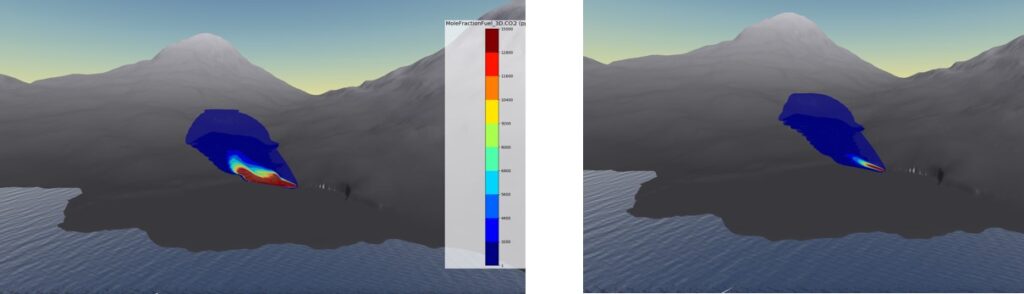
- Releases tend to slump and gather in low lying areas
- Small amounts of impurities have large effects on phase behaviour of CO2, affecting pipeline hydraulics (and routing), fracture dynamics, and corrosion protection required
- Accurate calculation of thermodynamic properties in the critical region is non-trivial, requiring specific equations of state
- CO2 undergoes a violent expansion as it depressurises
- Solid particles (dry ice) form in the cold depressurised CO2 jet (with potential for dry ice “grit blasting” effects), and subsequently sublimate
- CO2 blowdown must be controlled over long time periods to avoid excessively low temperatures
- Ambient temperatures can have a significant effect on the density and compressibility of CO2
- Long running ductile fracture propagation needs to be controlled through design of pipe toughness and/or crack arrestors
Services we provide
- Quantitative Risk Analysis: Physical Effects and Consequence Modelling | CFD
- Technical Safety Studies: EERA | Temporary Refuge | Impairment Assessment | Occupied Building Risk Assessment | Facility Siting | SIMOPs | Ship Collision Assessment
- Risk Reduction: ALARP Assessment | Risk Reduction | Workshop | Cost Benefits Analysis
- Leak Detection: Geographic 3D Detector Mapping | Scenario-based Detector Mapping
- Safety Case: Construction (Design & Management) Regulations Compliance | Safety Justifications | HSSE/Safety Case and COMAH Safety Report Development and Updates | Electronic/Living HSSE/Safety Cases
- Emergency Planning: Emergency and Crisis Scenario Identification | Emergency and Crisis Management Strategies/Plans/Procedures