Safety of Electric Vehicles for Aircraft Fuelling Operations
As the aviation industry seeks to decarbonise ground operations, the deployment of electric vehicles for ground service equipment is expected to play a key part. Electric vehicles, however, present unique hazards and it is important to understand the risk management measures required to ensure safe deployment, specifically when utilised for aircraft fuelling operations.

INTRODUCTION
As the aviation industry seeks to meet global sustainability and decarbonisation targets, a key focus area is in the reduction of emissions from Ground Service Equipment (GSE), which includes aircraft fuelling vehicles.
In order to safely introduce electric vehicles to their GSE fleet, airport facility owners/operators, fuel suppliers and aircraft operators require to understand whether any additional risks may be introduced for aircraft fuel handling operations at commercial airports.
The recent International Air Transport Association (IATA) Aviation Energy Forum (AEF) in May 2025 and Joint Inspection Group (JIG) Members Technical Forum (MTF) in June 2025 both featured panels discussing the challenges faced by electric vehicle deployment and how individual organisations have addressed these challenges. One common issue that was identified during discussions was that the existing standards for GSE and aircraft fuelling systems do not provide clear guidance on electric vehicles and that greater standardisation is required within the industry.
SYSTEM OVERVIEW
At present there are variations in the design of electric fuelling vehicles between fuelling operators, owners, and vehicle and fuel system manufacturers. Typically, designers use appropriate existing vehicle chasis, which they then modify to adapt the internal combustion engine technology to fully electric power. Differences can be seen in vehicle type (i.e. tanker vs hydrant dispenser), and with battery chemistries, which are expected to continue to evolve with the rapid development of new technology.
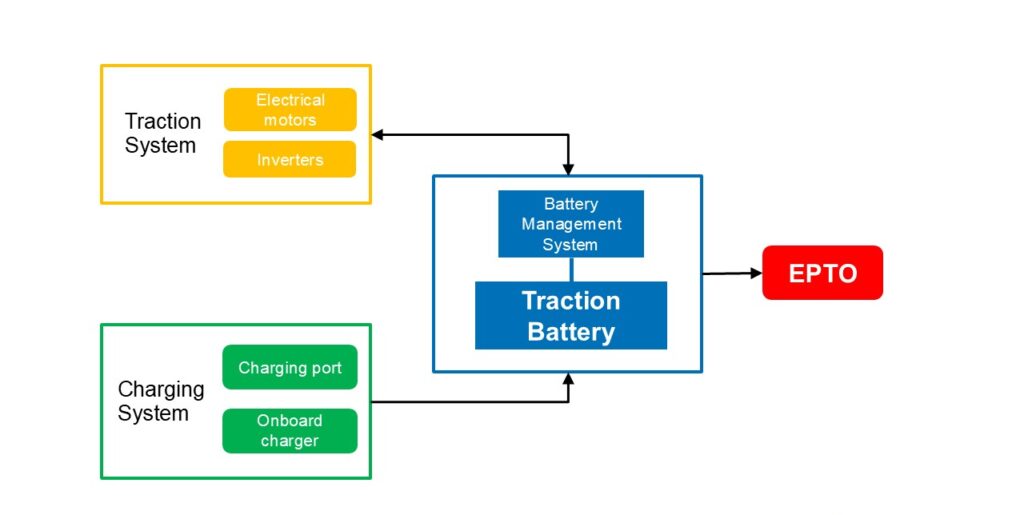
Within conventionally powered vehicles the internal combustion engine charges an auxiliary battery for vehicle functions, however, within electric vehicles the batteries provide energy for most of the systems on the vehicle, see Figure 2. This therefore introduces the need for a much larger battery than previously required.
Charging of electric vehicles at airport facilities is completed on site, utilising standard DC (fast charging) and AC (slow charging) facilities.
CURRENT STANDARD CHALLENGES
There are a number of applicable standards relating to aviation fuelling operations, such as BS EN 12312-5 (Ref. 1). These, however, were written for conventionally powered vehicles and at the time of writing have not been updated to consider the safe integration of electric vehicles.
Whilst electric vehicle standards have also been published, such as ISO 6469-3 (Ref. 2), the scope of these is limited to road vehicles and they do not include consideration of the hazards and risks associated with integrating fuel delivery equipment with a road vehicle chassis.
In Europe, The European Agreement concerning the International Carriage of Dangerous Goods by Road (ADR) (Ref. 3) and globally UNECE No. 100 Rev 3 (Ref 4.) provide some level of further guidance in this area but are not specific to the hazards and risks present in an airfield environment.
ELECTRIC VEHICLE HAZARDS
With differences in GSE electric vehicle design and limited clear guidance from industry standards, it can be beneficial to undertake formal risk assessment in order to justify that the use of the new technology is safe in the context of airport operations. This can identify the hazards which are present and aid the identification of any required risk reduction measures (or ‘safeguards’).
In order to identify and assess hazards from electric vehicles a well proven technique, such as a Hazard Identification (HAZID) study, is considered to be appropriate. The use of HAZID allows for a set of guidewords to be developed which are very specific to the use of electric vehicle technology in the context of airport operations. These guidewords would supplement more generic guidewords in order that a comprehensive hazard identification study is completed. A selection of high-level hazard categories which are expected to be present when deploying electric vehicles for aircraft fuel handling operations, and could therefore aid hazard identification, include:
- Battery fire, including battery thermal runaway.
- High-voltage systems in conjunction with fuel spill and/or vapour collection.
- High-voltage shock or electrocution to personnel.
- Loss of vehicle power.
- Other hazards, including vehicle collisions, vehicle dynamics and weather.
These high-level categories can provide a baseline for designers, owners and operators in the deployment of GSE electric vehicles.
SAFEGUARDING MEASURSES
Given the use of a new and evolving technology in GSE vehicles, it is likely that designers will require to incorporate a number of additional safeguards within their designs in order to mitigate any new risks resulting from the use of electric vehicles. The use of a structured risk assessment technique would allow for the identification of a number of safety functional requirements which could be tracked through design and design justification activities.
In terms of airport operations, it is likely that the combination of electric vehicle technology and GSE operations would result in a number of safeguards which may not have been required for conventional vehicles. These safeguards would cover both design and procedural elements in order to ensure appropriate risk reduction measure were in place. Furthermore, this would allow formulation of mitigation measures, such as emergency plans, which were appropriate to the technology in use.
TRAINING
As with any risk reduction process, it is most effective to design out risk to levels which are as low as reasonably practicable. However, given the nature of GSE operations there will always be a high reliance on people to undertake appropriate actions. As such it is vitally important that all applicable staff both directly and indirectly involved with electric vehicles within an airport are suitably trained and understand the specific risks associated with the use of the technology. Procedural controls identified during the risk assessment process would therefore focus on the personnel interacting with the electric vehicle, and would aim to ensure that the vehicle itself, and any emergency scenarios, are handled correctly. For example, specific measures may include:
- Operators should be trained in recognising the signs of, and appropriate response to a battery thermal runaway, to minimise the likelihood of battery fire spread to a jet fuel tank.
- Maintenance teams should be trained in battery maintenance and recognising collision damage in vehicles that may compromise battery integrity.
- Emergency services, in particular Aircraft Rescue and Firefighting (ARFF) crews should undergo training for fighting battery fires. It is often difficult to eliminate battery fires completely due to the stored energy in the battery, and the most effective way to manage the hazard is to isolate the vehicle so that the battery may be left to undergo a controlled burn.
With a full understanding of the hazard and risks presented, and appropriate safeguards identified and implemented, this can provide the basis for continued safe operations of electric aircraft refuelling vehicles now and into the future.
CONCLUSION
Deployment of electric vehicles within an airports GSE is a useful means of reducing emissions to help meet environmental targets. However, the use of electric vehicles introduces new hazards which need to be fully understood given the potentially significant consequences.
Current standards do not adequately cover the specifics of electrical vehicle use in tasks such as fuelling operations. Therefore, the use of proven risk management techniques, such as HAZID, would be beneficial to enable designers and operators to identify appropriate safety functional requirements and to track these through all aspects of electrical vehicle deployment.
References
- BS EN 12312-5:2021+A1:2025, Aircraft ground support equipment. Specific requirements Aircraft fuelling equipment
- ISO 6469:2019, Electrically propelled road vehicles — Safety specifications
- UNECE ADR, European Agreement concerning the International Carriage of Dangerous Goods by Road
- UNECE R 100, Revision 3