Multi-Criteria Decision Analysis (MCDA)
In today’s fast-paced and complex world decision-making is often a challenging task, especially when multiple factors and conflicting objectives are involved, but there are techniques which can help.

INTRODUCTION
As part of our daily lives we constantly make decisions, many are straightforward and with minimal factors to consider, however, when we are faced with decisions involving multiple criteria, or when the stakes are high, it can be beneficial to take a structured approach to reach a decision.
Multi-Criteria Decision Analysis (MCDA) is a powerful framework that helps individuals and organisations make such decisions in an informed manner.
WHAT IS MCDA?
MCDA is a structured approach to evaluating and comparing different options when decision-making involves multiple, often conflicting, criteria. The technique helps identify the best option by considering all relevant factors, prioritising them, and assessing how well each alternative performs against these factors.
MCDA is widely used in various fields, including business, healthcare, environmental management, urban planning and policymaking, where decisions are complex and involve trade-offs between different objectives.
MCDA CHARACTEREISTICS
MCDA provides a systematic and transparent process for decision-making, reducing the risk of bias and ensuring that all relevant factors are considered. By breaking down the decision-making process into clear steps, MCDA ensures that decisions are transparent, auditable and defensible.
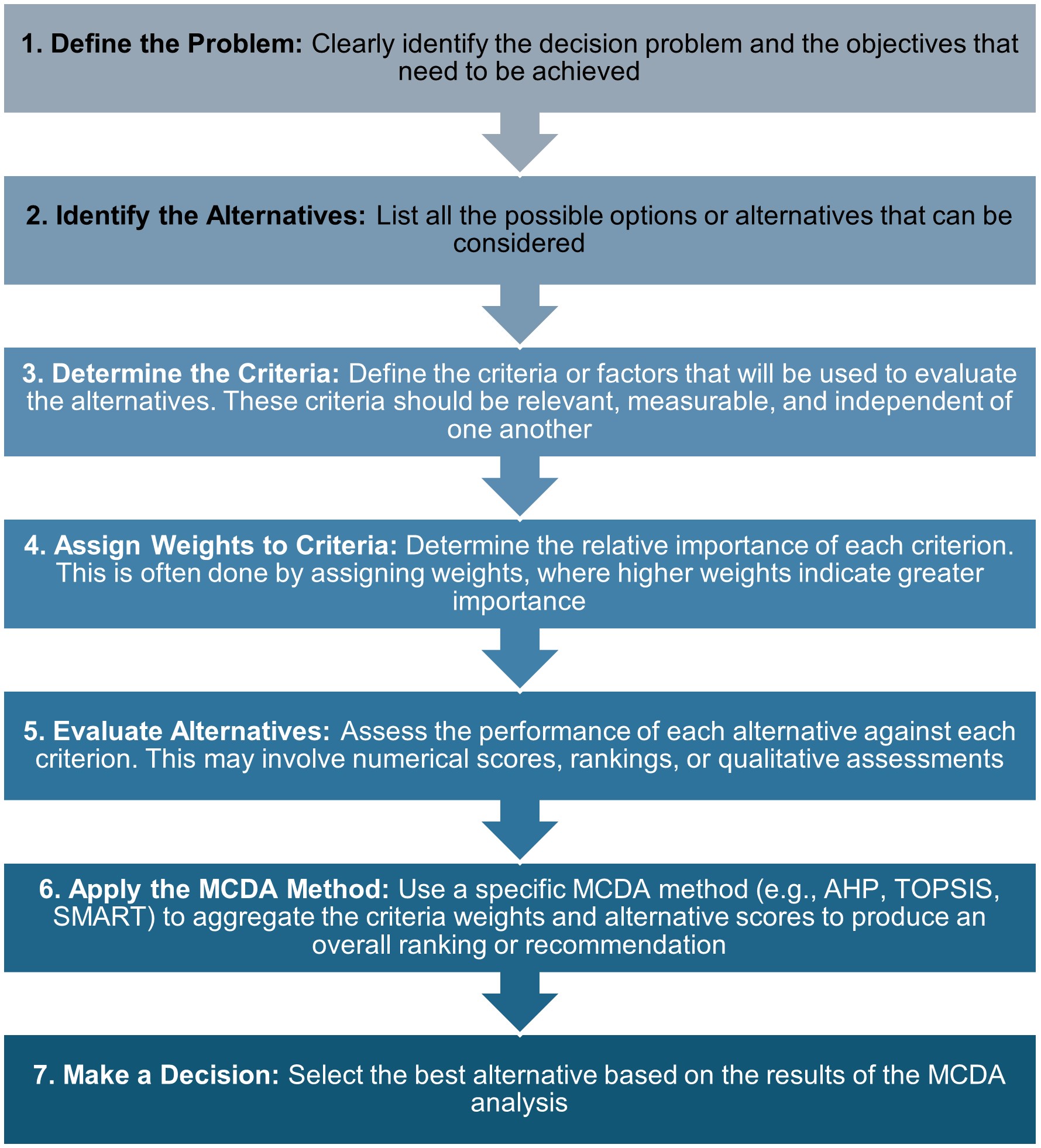
MCDA is designed to handle variations in input data, including where there is a mixture of qualitative and quantitative data, and involves several key steps, as shown in Figure 1.
This provides a number of advantages, including:
- Improved Clarity: MCDA helps decision-makers understand the problem structure and the trade-offs between different criteria.
- Handling Uncertainty: MCDA can incorporate uncertainty and sensitivity analysis to test how changes in criteria weights or alternative scores affect the decision.
- Enhanced Communication: MCDA provides a common language and framework for stakeholders to discuss and debate the decision.
- Robust Decision-Making: By considering multiple criteria, MCDA reduces the risk of making suboptimal decisions based on a single factor.
As with any technique, there are of course some challenges and limitations to be aware of. MCDA can be time-consuming and complex, especially when dealing with a large volume of criteria and alternatives, Additionally, MCDA requires high-quality data to produce reliable results, which can be problematic if data is incomplete or uncertain.
MCDA can also require input from multiple stakeholders, which can lead to conflicts and challenges in reaching consensus. The assignment of weights and the evaluation of alternatives can often involve subjective judgments, which has the potential to introduce unintended bias, so this must be managed with care through the process.
APPLICATION OF MCDA
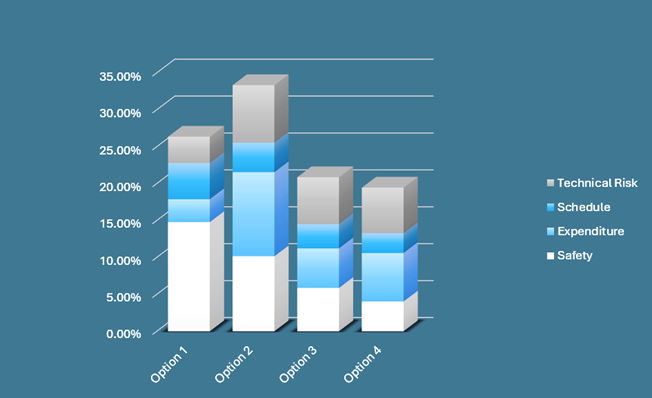
When utilising MCDA to assist decision making in an industrial application, several key categories, or ‘differentiators’, can form useful input to the MCDA process. An example MCDA output is shown in Figure 2, which presents the results when considering the following differentiators:
Technical Risk: Covers the technical risk considerations for the option, for example does the option increase or decrease technical risk, and to what degree. Additionally does the option require any specific means for managing technical risk, for example any functional safety requirements, (e.g. Safety Integrity Level (SIL) systems).
Schedule: What are the scheduling considerations for implementing the option, for example how long will it take to complete, how does it affect the overall project schedule and is there a seasonal dependency for when the work can be undertaken. There can also be drivers for implementing options as soon as possible, for example where a high-risk situation has been identified, and this can have scheduling implications.
Expenditure: The cost of developing and implementing the option. This can also potentially include any potential saving of cost or effort associated with the selection of the given option.
Safety: Considers the risk to personnel presented by the option, for example any requirements for people to work in hazardous areas during installation/execution, and any construction-related risk.
The differentiators for an MCDA study can be agreed relative to the project in question, but they can also include factors of specific relevance and importance to the decision making, for example:
- Environmental impact considerations.
- Decommissioning considerations either now or in the future.
- The actual predicted chance of success of the option.
- The extent of protection afforded by the option.
Careful selection of the differentiators ensures that the output generated provides a tangible and useful output into the decision-making process, and that the results generated can be used to provide clarity and suitable consideration of all the competing factors.
CONCLUSION
MCDA is a powerful tool for addressing complex decision-making challenges. By providing a structured and systematic approach, MCDA helps decision-makers evaluate alternatives based on multiple criteria, prioritise objectives, and make informed choices.
While MCDA has its limitations, its ability to handle uncertainty, improve transparency, and facilitate stakeholder engagement makes it an invaluable resource in both public and private sectors.